CCTV Rush Hour Strategy — Expert Betting Methods & Mathematical Analysis
Data-driven examination of every CCTV Rush Hour wagering approach by Georg Hurrison. Verified RTP figures, structured bankroll frameworks, and common misconceptions dismantled with hard numbers — not empty guarantees.
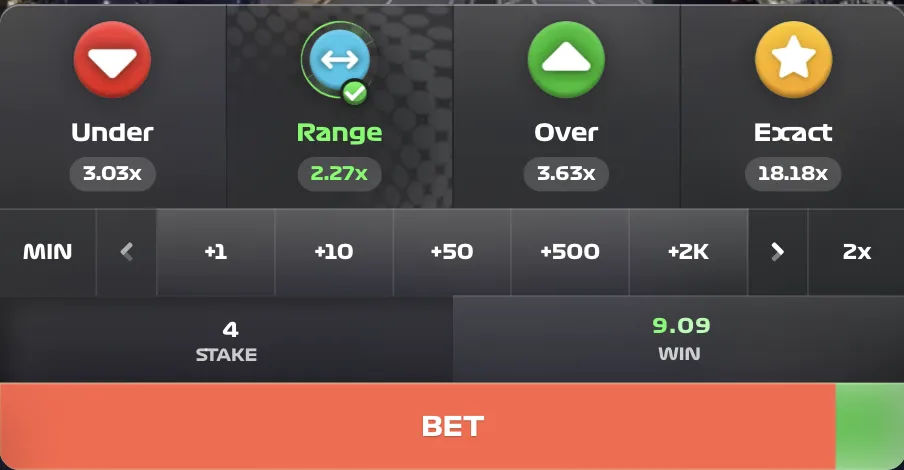
The strongest use of a strategy guide is preparation, not prediction. Read the notes before a session, choose one approach to test, and avoid mixing several systems just because the last round went badly. Most avoidable mistakes happen when players change targets too quickly, raise stakes out of frustration, or treat a short streak as proof that the game has become predictable.
Keep the plan small enough to follow when the pace gets quick. Demo rounds are useful for checking timing and comfort level, while real-money rounds should stay tied to a fixed budget, fixed stake range and clear exit point. That makes each decision easier to review later.
When you treat strategy as discipline rather than prediction, the experience becomes easier to manage. You still accept risk, but you make fewer rushed decisions, protect the bankroll better, and keep more control over the session. That is the kind of strategy that holds up after the first few rounds.
June 2026 Strategy Notes
Before you play Rush Hour CCTV, use this page to slow the session down. Look first at live-count markets, round observation and exact-count risk. These are the parts of the game that usually make a balance move faster, so choose your stake and stop point before the first round or spin. A small plan is easier to follow than a complicated system, especially after a quick win or a frustrating loss.
A useful warm-up is simple: watch the feed first, then choose whether the session suits range bets or slower pacing. Keep the same stake during the test, then write down the starting balance, ending balance and whether you stopped where you planned. That short note tells you more than a lucky result because it shows whether the plan was realistic while the game was moving.
If you play with a bonus, read the wagering rules, max bet, expiry date and withdrawal limits before changing anything. The best strategy is usually the one that keeps decisions calm: clear limits, fewer rushed clicks and no attempt to win back a result that has already happened.
No Approach Can Overcome the House Edge
With a house edge of 6.5–8.5%, the operator always comes out ahead across a large volume of bets. Every method outlined on this page exists to help you structure your sessions and limit losses — not to create a revenue stream. CCTV Rush Hour is a gambling product, and its mathematical design guarantees the platform retains a portion of all money wagered over time.
Should you wager $1,000 spread across numerous rounds, your anticipated return falls between $915 and $935 on average. The $65–$85 difference represents the price of participation. Individual sessions will fluctuate — you might finish ahead or well behind — but the long-term trajectory invariably favours the operator.
If you find yourself in financial difficulty or gambling starts to feel compulsive rather than recreational, please consult our Responsible Gaming page for available support services.
The Mathematics Behind CCTV Rush Hour
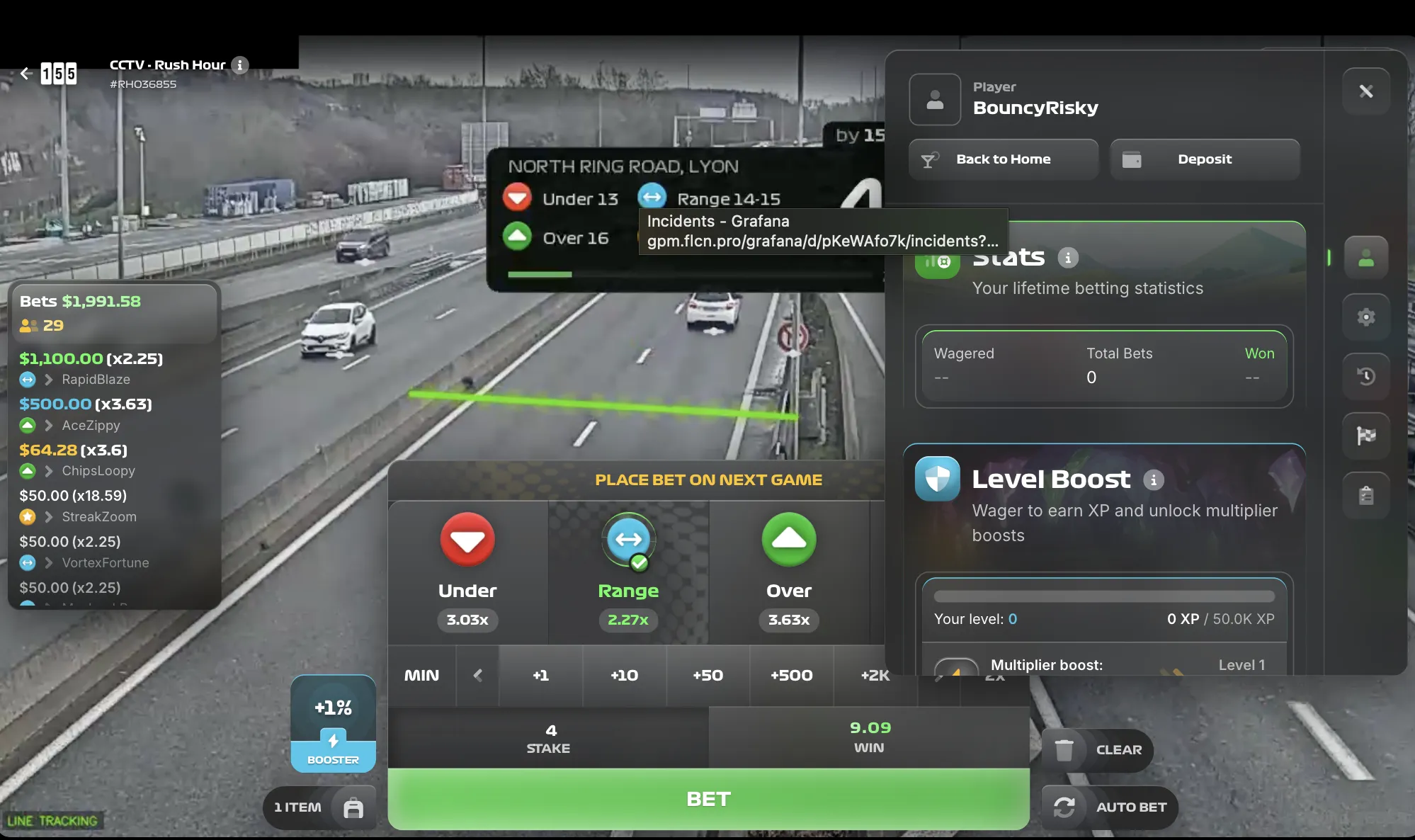
CCTV Rush Hour game interface with live camera feed, betting panel, and player statistics
Prior to evaluating any approach, it is essential to grasp the figures that underpin every CCTV Rush Hour round. These are not subjective views or rough estimates — they constitute the mathematical scaffold determining long-term results. Whichever strategy you adopt, these numbers govern every wager you make. If you are new to the game, read the CCTV Rush Hour betting tiers guide before proceeding.
How Return to Player (RTP) Works
RTP, or Return to Player, is a percentage figure. In CCTV Rush Hour, the RTP falls between 91.50% and 93.50% based on your chosen bet category. This metric reflects the theoretical share of all wagered funds returned to players across a vast number of rounds — generally hundreds of thousands or even millions.
Below is a practical illustration using a €1,000 cumulative wager:
| Bet Type | RTP | Expected Return on €1,000 | Expected Loss on €1,000 |
|---|---|---|---|
| Under / Over | ~93.50% | €935.00 | €65.00 |
| Range | ~92.50% | €925.00 | €75.00 |
| Exact | ~91.50% | €915.00 | €85.00 |
Keep in mind that these are long-run averages. Across a single session of 50 rounds, your real-world results could diverge substantially in either direction. This variance is precisely what gives gambling its unpredictable feel — and why certain players wrongly conclude they have discovered a winning formula after a handful of profitable sessions.
How the House Edge Is Derived
The house edge is simply the RTP subtracted from 100%. For CCTV Rush Hour, the figures are:
- Under / Over: 100% − 93.50% = 6.50% house edge
- Range: 100% − 92.50% = 7.50% house edge
- Exact: 100% − 91.50% = 8.50% house edge
To put this in context, blackjack played with optimal strategy carries a house edge below 1%. European roulette sits at 2.7%. The majority of crash games operate in the 3% to 5% range. CCTV Rush Hour's edge exceeds all of these, meaning your funds erode more quickly relative to the total bets placed. This alone is not grounds to skip the game — plenty of players consider the live camera format worth the added cost — but it is a fact you must weigh when planning your sessions.
Distinguishing Variance from Expected Value
Expected value (EV) represents your average outcome over tens of thousands of rounds. Variance describes how widely your actual results fluctuate above and below that average in shorter periods. CCTV Rush Hour exhibits medium volatility, which translates to:
- You will not see the wild swings typical of high-volatility slots (where 500 empty spins preceding a huge payout is standard)
- You will not see the modest, gradual fluctuations common in low-volatility games such as baccarat
- Over 50–100 rounds, visible peaks and dips are normal, but genuinely catastrophic swings are uncommon
In practical terms: a 50-round session at $1 per wager ($50 total staked) might leave you up $10 or down $20. Both fall within expected variance. Across 5,000 rounds at $1 each ($5,000 total wagered), you will almost certainly be down $325–$425 — the statistical portion claimed by the house at that volume.
Why the Gambler's Fallacy Is Wrong
The gambler's fallacy is the mistaken conviction that prior results shape future outcomes in independent events. Each CCTV Rush Hour round relies on a fresh live camera observation window. The pedestrians and cars captured during one 55-second round bear no relationship to those in the following round. If "over" has come up five consecutive times, the odds of "over" on the next round remain exactly unchanged.
Traffic patterns do exhibit certain time-of-day tendencies (heavier movement during peak commuting hours, lighter activity overnight), but within any particular time window, individual round results are effectively independent. A camera registering 12 pedestrians in one round does not make 8 pedestrians any more or less probable in the subsequent round. The city streets do not "owe" you a low count simply because several high counts have appeared.
This fallacy stands as the single costliest misconception in gambling. It fuels chase behaviour, where players raise their stakes after losses because they feel a win is "overdue." It is not. Every round constitutes its own discrete event.
CCTV Rush Hour Strategy 1: The Conservative Method (Low Risk)
The conservative CCTV Rush Hour strategy centres on maximising session duration while keeping losses tightly controlled. It is designed for players who view the game as entertainment and want to stretch a fixed budget as far as possible. This approach will not deliver massive payouts, but it substantially reduces the risk of rapid bankroll erosion.
Fundamental Principles
- Bet type: Under or Over bets exclusively (~93.5% RTP). These carry the best return rate in CCTV Rush Hour and generate the steadiest outcomes.
- Stake size: No more than 1% of your session bankroll per round. On a €100 bankroll, that equates to €1 wagers.
- Session time limit: 60 minutes at most, irrespective of whether you are ahead or behind.
- Session money limit: Walk away after losing 30% of your initial bankroll. Walk away after gaining 50% of your initial bankroll.
Conservative Strategy Bet Sizing Reference
| Session Bankroll | Max Bet (1%) | Expected Rounds Before Depletion | Estimated Session Time |
|---|---|---|---|
| €50 | €0.50 | ~90–120 rounds | ~80–110 minutes |
| €100 | €1.00 | ~90–120 rounds | ~80–110 minutes |
| €200 | €2.00 | ~90–120 rounds | ~80–110 minutes |
| €500 | €5.00 | ~90–120 rounds | ~80–110 minutes |
The projected round count stays broadly consistent regardless of bankroll size, since the wager scales proportionally. With Under/Over bets at 93.5% RTP and 1% bet sizing, the house edge erodes your balance by roughly 0.065% per round (6.5% of 1%). That works out to approximately 100 rounds of comfortable play before variance starts squeezing your balance toward zero.
Ideal Player Profile
The conservative CCTV Rush Hour strategy suits players who treat the game as paid entertainment — similar to buying a cinema ticket. You are paying for the experience of watching real CCTV feeds worldwide and making predictions, with the understanding that this entertainment has a cost. At €1 stakes on a €100 bankroll, the average spend runs about €6.50 per hour. Before committing real funds, use the CCTV Rush Hour free demo to apply this strategy risk-free and build confidence.
This strategy is not suited to players chasing large payouts. The ceiling on Under/Over bets is modest compared to Exact. If you want a shot at 18x returns, you must accept elevated risk — covered in Strategy 3.
CCTV Rush Hour Strategy 2: Observation-Based Method (Medium Risk)
The observation-based strategy adds a research dimension to your CCTV Rush Hour betting decisions. Because the game draws on genuine live CCTV camera footage from real urban locations worldwide, authentic fluctuations in traffic volume occur throughout the day, the week, and by camera location. This strategy attempts to leverage that context — while being completely honest about its substantial limitations.
Observable Factors
- Time-of-day traffic volumes: The morning commute (7–9 AM local time) and the evening rush (5–7 PM) reliably produce elevated pedestrian and vehicle totals. Late night (11 PM–5 AM) delivers the lowest levels of activity. This is the most dependable observable trend.
- Camera location traits: A camera positioned above a congested Tokyo intersection yields fundamentally different count ranges than one monitoring a quiet suburban road in Eastern Europe. Take time to learn each location before wagering.
- Weather and seasonal influences: Rainfall visibly suppresses pedestrian totals. Summer evenings generally produce more foot traffic than their winter equivalents. These conditions are directly visible in the live feed.
- Special events: On occasion, local happenings (sporting fixtures, concerts, parades) generate atypical surges in activity near a camera location.
The Observe-Before-You-Bet Approach
Before committing your first wager on any given camera location, watch 2–3 complete rounds as a spectator. Access the CCTV Rush Hour free demo mode to practice this observation technique without staking real money. During this observation window:
- Gauge the overall traffic density — is this a peak period or a quiet spell?
- Estimate the rough range of pedestrians or vehicles traversing the viewing zone each round
- Scan for atypical circumstances (roadworks, closures, sudden weather shifts)
- Settle on a target count range informed by what you have witnessed
Suggested Bet Type: Range
The observation-based CCTV Rush Hour strategy pairs naturally with Range bets. You are forming educated predictions about count bands based on what you see in the live feed — and Range pays out when the AI count falls within your chosen interval. Its RTP of roughly 92.5% sits between the safety of Under/Over and the risk of Exact, matching the medium-risk character of this approach.
Acknowledging Pattern Limitations
Monitoring traffic can offer a slight improvement in prediction accuracy compared to guessing blindly. But the gain is marginal and tough to measure precisely. Consider pattern observation a means of making better-informed choices, not a mechanism that alters the fundamental mathematics governing the game.
A frequent pitfall: players who invest time watching begin to trust their predictions more than the evidence justifies. That inflated confidence tends to drive larger bets, which accelerates the rate of loss. Maintain strict bet sizing discipline no matter how "sure" you feel about a particular round.
CCTV Rush Hour Strategy 3: The Aggressive Method (High Risk)
The aggressive CCTV Rush Hour strategy suits players who are prepared to absorb steeper potential losses in pursuit of bigger rewards. This method relies on Exact bets, which offer the peak 18x multiplier but carry the lowest RTP at roughly 91.5%.
How Exact Bets Work in CCTV Rush Hour
An Exact bet requires you to predict the precise vehicle or pedestrian count the AI will register during the round. Because the prediction must match exactly, the per-round win probability is low — but the payout when you hit is considerably larger. The 18x maximum multiplier means a $10 Exact bet returns $180 when your prediction is correct.
The Short Session Model
Given the 8.5% house edge, the maths work against you at a faster pace than with Pick Winner wagers. The aggressive approach offsets this by employing very brief sessions:
- Session length: 10–15 rounds at most. At 55 seconds per round, that amounts to roughly 10–14 minutes.
- Bet sizing: 2% of bankroll per round (above the conservative threshold, matching the elevated risk profile).
- Target: Land one or two successful bets per session. If you connect on an 18x payout early, stop. If 10 rounds pass without a win, stop.
- Frequency: Restrict yourself to one or two high-risk sessions per week.
The Martingale Failure — A Mathematical Demonstration
Many players try a Martingale-inspired approach alongside high-risk bets: doubling the stake after each loss so the first win recoups everything. Here is the mathematical proof of why this inevitably fails:
Suppose you begin with a $1 Exact Order bet and double following each loss:
| Round | Bet Amount | Total Invested | Win at 18x Pays | Net Profit if Win |
|---|---|---|---|---|
| 1 | $1 | $1 | $18 | +$17 |
| 2 | $2 | $3 | $36 | +$33 |
| 3 | $4 | $7 | $72 | +$65 |
| 4 | $8 | $15 | $144 | +$129 |
| 5 | $16 | $31 | $288 | +$257 |
| 6 | $32 | $63 | $576 | +$513 |
| 7 | $64 | $127 | $1,152 | +$1,025 |
| 8 | $128 | $255 | $2,304 | +$2,049 |
| 9 | $256 | $511 | $4,608 | +$4,097 |
| 10 | $512 | $1,023 | $9,216 | +$8,193 |
By the tenth round, a single bet costs $512 and your cumulative outlay reaches $1,023. Most casino betting limits will cap your wager well before this stage. More importantly, the probability of losing 10 straight Exact Order bets is substantial — with a per-round win probability near 5.5%, the chance of 10 consecutive losses is approximately 56%. In other words, more than half of all Martingale sequences spanning 10 rounds will collapse entirely.
The Martingale does nothing to alter the expected value of your bets. It merely reshapes your losses into infrequent but devastating episodes. Over hundreds of sessions, you will encounter those devastating losses, and they will more than cancel out every small win collected along the way. This is not conjecture — it is a mathematical inevitability given a sufficient sample size.
When the Aggressive Approach Is Justified
The high-risk method is suitable only when you have set aside a specific sum you are truly prepared to lose in full, and when your goal is a brief, intense session rather than prolonged play. Think of it as purchasing a lottery ticket instead of paying for an evening of leisure. The anticipated cost is steeper, but the potential payout from a single winning round is far greater.
Bankroll Management for CCTV Rush Hour
Bankroll management is the only dimension of CCTV Rush Hour where you exercise genuine control. You cannot influence the live CCTV outcomes, the RTP, or the house edge. What you can control is how much you bring to each session, how much you stake per round, when you stop, and how often you play. Every strategy on this page depends on disciplined bankroll management to function at all. Players who need support setting limits should consult our responsible gaming resources.
Breaking Down the 1% Rule
The 1% rule is simple: never put more than 1% of your current session bankroll at risk on any single round. If you begin with $100, your ceiling is $1. If your balance slips to $80, your ceiling drops to $0.80. If your balance climbs to $130, you may raise it to $1.30.
This proportional scaling achieves two objectives. First, it shields you from a brief losing streak decimating your session. Ten consecutive losses at 1% sizing costs roughly 9.6% of your bankroll (slightly under 10% because each successive wager is placed on a reduced balance). By contrast, a player staking 10% per round would see the identical 10-round losing streak wipe out 65% of their funds.
Second, the 1% rule naturally decelerates your activity as your balance shrinks, granting you additional rounds — and additional entertainment — from a dwindling bankroll. It operates as a built-in safety brake that grows more cautious as you near your loss threshold.
Setting Session Boundaries: Time and Money
Establish both constraints before you begin, and adhere to them without exception:
- Time limit: Cap conservative sessions at 60 minutes, high-risk sessions at 15 minutes. Use a phone timer. When it sounds, you stop — regardless of your current balance.
- Loss limit (stop-loss): Cease play after losing 30% of your starting bankroll. Starting at $100 means quitting at $70. This safeguards the bulk of your funds for subsequent sessions.
- Win limit (take-profit): Cease play after gaining 50% of your starting bankroll. Starting at $100 means quitting at $150. Securing profits averts the widespread habit of winning and then surrendering all gains during extended play.
The Psychology of Stop-Loss and Take-Profit
Enforcement is the most challenging element of bankroll management. Upon reaching your stop-loss, the urge to "claw it back" will be powerful. Upon hitting your take-profit, you will sense you are riding momentum and should continue. Both impulses stem from emotional reactions, not rational evaluation.
The mathematics remain constant regardless of your session trajectory. If 30% of your bankroll has vanished, the house edge on your upcoming bet is precisely the same as it was on your opening bet. A recovery is not "owed" to you. Equally, if you are up 50%, the house edge on the next wager is unchanged. The game neither knows nor cares about your cumulative result.
Commit to your boundaries in advance by writing them down before playing. Some players benefit from a physical prompt — a note beside their monitor or a phone alarm. Casino platforms also provide deposit caps and session timers within their responsible gambling toolkits. Take advantage of them.
Recognising Emotional Tilt
Tilt is a poker term describing emotional decision-making that overrides sound strategy. In CCTV Rush Hour, tilt commonly appears as:
- Raising bet sizes after losses in an attempt to "recover" faster
- Shifting from Pick Winner to Exact Order bets while losing, chasing the 18x multiplier
- Disregarding session limits because "one more round" might turn things around
- Making additional deposits beyond your planned session bankroll
If you catch yourself exhibiting any of these behaviours, stop playing at once. Close the browser or app. Return on a different day. No single CCTV Rush Hour round is worth making financial choices from an emotional place. The game operates around the clock, every day of the week — it will still be available when you are composed and thinking rationally.
Common CCTV Rush Hour Betting Myths Exposed
Online forums are full of CCTV Rush Hour "systems" and "guaranteed strategies." None of them hold up to scrutiny. Below are the most widespread myths, with the mathematical reasons each one fails.
Myth 1: "A Win Is Overdue After Losses"
This is the gambler's fallacy distilled to its essence. Following a sequence of losses, many players convince themselves the next round is more likely to produce a win. This is untrue. Every 55-second live camera observation window represents an independent event. The pedestrians crossing a camera zone at 3:15 PM have zero connection to those captured at 3:14 PM.
The probability of any particular outcome does not shift based on preceding rounds. If Pick Winner bets carry an approximate 50% win rate, then after 5 straight losses the likelihood of winning the 6th bet remains 50% — not higher. The chain of past results exerts no influence on the next independent event.
Myth 2: "Progressive Betting Systems Ensure Profit"
Martingale, Fibonacci, D'Alembert, Labouchere — every progressive staking system shares an identical core weakness. They alter the distribution of gains and losses without modifying the expected value. The house edge is applied to each bet irrespective of your staking pattern.
A straightforward demonstration: if your expected loss on a single $1 bet is $0.065 (6.5% house edge), then your expected loss across 100 bets of varying sizes totalling $1,000 in wagers is $65. Whether those bets were uniformly $1 each, or a sequence of $1, $2, $4, and so on, makes no difference. The aggregate expected loss always equals the house edge multiplied by the total amount staked.
Progressive systems create the appearance of success because they generate numerous small profits and infrequent large setbacks. Over brief stretches, you may encounter only the small profits and decide the system is effective. But the major losses will materialise eventually, and they will wipe out all those incremental gains. This is not a question of "if" but strictly "when."
Myth 3: "Bigger Bets Yield Better RTP"
CCTV Rush Hour's RTP is determined by the payout structure, not your bet amount. A $0.50 Pick Winner bet carries precisely the same 93.5% RTP as a $500 Pick Winner bet. Increasing your wager raises the absolute dollar sums you can win or lose, but it does not shift the percentage the operator retains.
Some players conflate this with certain slot games where higher denominations occasionally unlock superior RTP. That dynamic simply does not exist in CCTV Rush Hour. The house edge is uniform irrespective of stake size.
Myth 4: "Traffic Patterns Can Be Read With Accuracy"
As explored in Strategy 2, broad traffic trends are genuine — peak hours are busier than midnight, and weekdays differ from weekends. However, the specific tally within any individual 55-second window carries too much randomness to forecast reliably. A bustling intersection might average 15 pedestrians per minute, yet the standard deviation around that average is wide enough that round-by-round totals vary dramatically.
Players who believe they can "decode" traffic patterns frequently fall prey to confirmation bias — recalling the rounds where their forecast proved correct and discounting the ones where it missed. Maintaining an honest written log of predictions versus actual outcomes will swiftly demonstrate that traffic reading delivers, at best, a marginal edge over random guessing — nowhere close to enough to neutralise the 6.5–8.5% house edge.
CCTV Rush Hour Strategy Comparison Table
The table below presents all three CCTV Rush Hour strategies side by side. Choose the approach that matches your risk tolerance, bankroll size, and session goals.
| Strategy | Risk Level | Recommended Bet Type | RTP | Session Length | Best For |
|---|---|---|---|---|---|
| Conservative | Low | Under / Over | ~93.5% | 60–90 minutes | Extended entertainment, bankroll preservation |
| Observation-Based | Medium | Range | ~92.5% | 30–60 minutes | Analytical players who enjoy studying CCTV feeds |
| Aggressive | High | Exact | ~91.5% | 10–15 minutes | Short, high-intensity CCTV Rush Hour sessions |
No single CCTV Rush Hour strategy is universally superior. The conservative method provides the longest session time and the gentlest bankroll decline. The aggressive method opens the door to 18x payouts but depletes funds quickly. The observation-based approach occupies the middle ground with an analytical angle that many players find compelling — even if its measurable edge over random prediction is marginal.
You can also blend strategies within one session. A popular CCTV Rush Hour hybrid involves placing 80% of wagers as Under/Over bets while reserving 20% for Range or Exact bets. This keeps session length stable while creating periodic shots at larger multipliers. Just ensure your combined staking stays within your bankroll management plan.
Optimistic Strategy Outlook
CCTV Rush Hour has a constructive strategic angle because its bet types make risk visible before the 55-second round resolves. Under and Over bets suit longer sessions with gentler variance, Range bets give analytical players a more focused middle ground, and Exact bets can be reserved for tiny, pre-planned shots at the 18x ceiling. That structure is encouraging because a player can blend the bet types intentionally instead of reacting to the traffic feed after every result. The 91.5%-93.5% RTP range still favours the house, but clear bet categories make bankroll planning more concrete.
The optimistic way to use the live CCTV format is to slow the session down. Observe the feed, decide the stake split before betting, and keep any Exact wager inside a small entertainment allocation. Demo mode can teach the rhythm of Under, Range, Over, and Exact outcomes without financial pressure. When the plan is written first, CCTV Rush Hour becomes a readable prediction game with controlled exposure rather than a rush to recover the last round.
CCTV Rush Hour Strategy: Frequently Asked Questions
No. A house edge of 6.5–8.5% is embedded in every available bet type. Across thousands of rounds, the casino invariably turns a profit. Strategies can smooth out variance and prolong your sessions, but they cannot remove the mathematical advantage the operator holds. Anyone asserting they have a foolproof winning system is either uninformed or misleading you. The most you can do is pick the approach that best fits your risk tolerance and entertainment budget.
Under and Over bets deliver the highest CCTV Rush Hour RTP at roughly 93.5%, making them the lowest-risk options. The house edge on Under/Over sits around 6.5%, compared to 8.5% on Exact bets. Although payouts are more modest, the greater win frequency means less variance and longer sessions from a given bankroll. If your goal is to maximise entertainment time relative to money spent, Under/Over bets are the obvious starting point.
No. The Martingale approach (doubling your wager after every loss) collapses for three reasons: table limits prevent bet sizes from reaching the levels required for recovery, bankroll constraints mean you exhaust your funds during extended losing runs, and the house edge is levied on every bet regardless of its size. A losing streak of 10 rounds demands 1,024 times your opening stake, and sequences like that arise more frequently than most players anticipate. The Martingale does not shift the expected value — it merely concentrates your losses into uncommon yet ruinous episodes.
Applying the 1% rule (never putting more than 1% of your bankroll at risk per round), a $100 bankroll caps you at $1 maximum bets. At that level using Pick Winner bets, you can anticipate roughly 90–120 rounds before the house edge erodes your funds, equating to approximately 80–110 minutes of gameplay. The guiding principle is straightforward: only use money you can genuinely afford to lose completely. Your session bankroll should be an amount whose total loss would cause you zero financial hardship.
Observing 2–3 rounds prior to placing wagers can help you familiarise yourself with the active camera location and prevailing traffic conditions. During peak commuting hours, pedestrian and vehicle counts tend to be elevated and somewhat more consistent. That said, this observation yields a limited statistical advantage since traffic patterns involve considerable randomness at the level of individual rounds. Regard observation as a research exercise rather than a dependable forecasting technique. It will not overcome the house edge, but it may help you steer clear of clearly misguided predictions on unfamiliar camera feeds.
CCTV Rush Hour's RTP of 91.5–93.5% sits on par with mid-tier slots and marginally below many crash games (which commonly provide 95–97% RTP). CCTV Rush Hour's distinguishing feature is its real-world live camera component, which certain players find more immersive and transparent than RNG-driven titles. The trade-off is the comparatively steep house edge. Determining the "best" game is ultimately subjective and hinges on your entertainment preferences, risk appetite, and how highly you value the live-content format versus pure mathematical efficiency.
Traffic density shifts in predictable ways throughout the day. The morning rush (7–9 AM local camera time) and evening rush (5–7 PM) generally feature higher pedestrian and vehicle totals. Overnight hours produce lower counts. While these overarching trends are genuine and visible, the exact figure within any specific 55-second round remains unpredictable owing to natural randomness. Awareness of time-of-day patterns can guide your broad predictions but does not furnish a reliable advantage over the house. The house edge of 6.5–8.5% holds constant around the clock.
No. Unlike card games with finite decks, CCTV Rush Hour outcomes depend on live traffic — an inherently chaotic system with no repeating sequence. Historical data may reveal general tendencies for a location, but each round is independent.
Under bets on high-traffic feeds offer the lowest variance with multipliers around 1.5x–2.5x. They win more frequently but pay less per win. For longer sessions with smaller bankrolls, this is the most sustainable approach.
A practical guideline is 40–60x your average stake. At €1 per round, bring €40–€60 for a comfortable session. This buffer absorbs losing streaks while keeping you in the game long enough for variance to even out.
Yes. A common approach is allocating 70–80% of your round budget to Under or Over bets for steady returns, and 20–30% to Exact or Narrow Range bets for higher-variance upside. This balances risk across each round.
Explore More CCTV Rush Hour Resources
Browse our additional guides for a comprehensive understanding of CCTV Rush Hour by 155.io:
Full rules walkthrough covering all three bet categories, round mechanics, multipliers, and payout tables. The ideal starting point for newcomers to the game.
Read the Rules →Practise CCTV Rush Hour predictions using virtual credits. Most platforms require no sign-up or deposit. An ideal environment for testing all three strategies without financial risk.
Try the Demo →Evaluate welcome deals, cashback promotions, and free spins from all CCTV Rush Hour casino partners. Refreshed monthly with the latest available offers.
View Bonuses →Apply our exclusive promo code when registering to unlock enhanced welcome bonuses at all CCTV Rush Hour partner casinos, including up to 500% deposit match.
Get Promo Code →Install CCTV Rush Hour on your mobile device. Android APK download, iOS PWA setup, and desktop browser optimisation guides included.
Download Guide →Step-by-step account creation at the top casino platforms offering CCTV Rush Hour. Covers KYC verification, deposit methods, and first-login tips.
Registration Guide →Our comprehensive independent assessment covering RTP data, streaming performance, partner casinos, and an honest final verdict. Features player testimonials and an expert score.
Read Full Review →Session Budget Simulator
Run a quick 100-round preview using the current official 90% base-return model. Each option combines one market with a fixed percentage stake. For fixed seeds, disclosed assumptions and four complete 10,000-round models, read Georg's reproducible simulation report.